Skip to content

Replacing commercial HVAC in a 5,000-square-foot office in Modesto, CA, involves more than pricing new rooftop units. The total cost depends on the building’s cooling load, existing ductwork, electrical capacity, roof access, and any required code upgrades. Two offices of the same size can have very different replacement budgets depending on the condition of their existing systems.
Per-square-foot estimates can help with early budgeting, but they often exclude important installation costs. This guide explains the major expenses involved in replacing commercial HVAC, what can drive your project cost up or down, and how to compare contractor bids before approving a replacement.
Why Do Commercial HVAC Cost-per-Square-Foot Figures Vary So Much?

Two different calculations circulate under the same label. One prices equipment and installation only. The other prices a complete system including new ductwork, electrical capacity and controls. The first lands at the bottom of the published range, the second at the top, and both are honest answers to different scopes.
Contractors quote from the first basis when your ducts are sound and your panel has capacity. Engineers and cost estimators publish the second because they are usually pricing new construction or a gut retrofit. Neither party is inflating anything, which is why a bid comparison fails unless the scope is matched first.
For a replacement in an existing Modesto office, the realistic all-in band is roughly $7 to $20 per square foot. Where you land inside that depends almost entirely on the condition of what is already in your building rather than on the equipment you choose to put on the roof.
How Much Tonnage Does a 5,000 Sq Ft Office Need?
Tonnage is the measure of cooling capacity, and it drives most of the equipment cost. The common commercial rule allocates one ton per 350 to 450 square feet, which puts a 5,000 sq ft office somewhere between 11 and 14 tons before any adjustment for climate or occupancy.
Modesto pushes that toward the heavy end. Sustained triple-digit afternoons keep the sensible load high for hours rather than peaking briefly, and a full office adds people, laptops, lighting and server equipment on top. Most 5,000 sq ft offices here land near 14 or 15 tons, often configured as two 7.5-ton rooftop units.
That arithmetic is a starting point, not a scope. A Manual N load calculation measures your building’s own heat gain from glazing, orientation, insulation and occupancy, and it is the only thing that settles tonnage. Any bid that names a tonnage without one is quoting a guess at your expense.
What Does Each Line Item Cost for a 5,000 Sq Ft Office?
The table below itemizes a two-unit rooftop replacement for a 5,000 sq ft single-story office. These are general Modesto-area planning ranges rather than a quote, and they exist so you can tell which items a bid has left out when it comes in unusually low.
| Line item | General Modesto range |
|---|---|
| Two 7.5-ton packaged rooftop units, installed | $22,000–$45,000 |
| Duct replacement or resizing | $8,000–$30,000 |
| Electrical service upgrade, where needed | $2,000–$8,000 |
| Curb adapters, both units | $1,000–$4,000 |
| Crane lift, half day | $1,200–$1,800 |
| Permits, disposal, roof patching and controls | $1,750–$9,300 |
Add the low column and you reach roughly $36,000, which is $7.20 per square foot. Add the high column and you reach roughly $98,000, close to $20 per square foot. The equipment barely moved between those two totals. The building work is what nearly tripled the number.
Notice that duct replacement alone can exceed the cost of both rooftop units. That one line is the most common reason two bids on the same office land thousands apart, and it is the first thing to check when a contractor’s number looks too good against the others in your stack.
Which Costs Change a Commercial HVAC Replacement Budget Most?
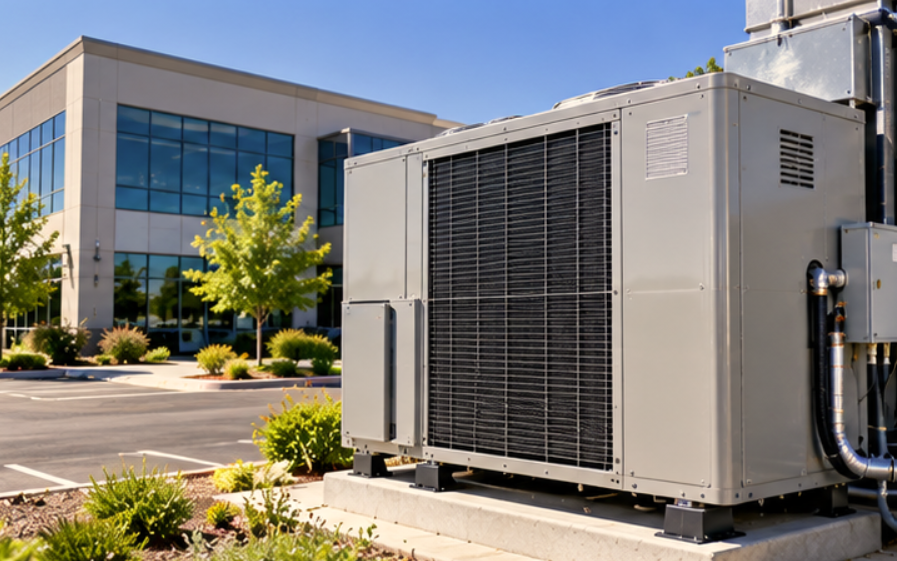
The largest cost differences often come from the building’s existing condition rather than the rooftop equipment alone. Ductwork, electrical capacity, roof access, and required code upgrades can change the amount of labor and additional trades involved. These items should be inspected and documented before a contractor finalizes the replacement scope.
Ductwork Sized for the Proposed Equipment
Existing ductwork must be capable of delivering the airflow required by the selected equipment. Undersized, leaking, or poorly configured ducts can contribute to excessive static pressure, uneven temperatures, and reduced system performance. A contractor should evaluate duct condition and airflow before deciding whether the existing distribution system can be reused or needs modification.
Electrical Capacity and Disconnects
New equipment may require different electrical connections, disconnects, wiring, or circuit capacity than the existing unit. Whether upgrades are necessary depends on the proposed equipment and the building’s electrical system. Confirm the electrical scope with the contractor and a qualified electrician where needed, so required work is included in the budget rather than discovered during installation.
Crane Access and Roof Condition
Replacing packaged rooftop equipment may require a crane, and the cost depends on lift height, reach, access, site restrictions, and scheduling. Removing an existing unit can also reveal damaged flashing, deteriorated roof materials, or incompatible equipment curbs. An early site assessment helps identify these conditions and clarify which roof-related expenses are included in the proposal.
Permits and California Energy Code Requirements
Commercial HVAC replacements may require permits, inspections, and compliance with applicable California energy and mechanical requirements. The specific obligations depend on the project scope, equipment, and rules in effect when the work is performed. Confirm the permitting authority and applicable requirements for the property before finalizing the budget, rather than assuming every replacement triggers the same upgrades.
How Does the A2L Refrigerant Switch Affect Your Budget?
New commercial equipment now ships with A2L refrigerants, a mildly flammable, lower-global-warming-potential class that replaced R-410A. Under the federal AIM Act phasedown, which cuts production of high-GWP refrigerants by 60 percent between 2024 and 2028, manufacturers moved to this class starting in 2025, and R-454B is what most new rooftop units carry today.
The redesigned equipment, leak-detection requirements and updated handling practices are already priced into current quotes. Buying remaining R-410A stock to save money is the false economy here, because that refrigerant is in a scheduled phasedown and future top-offs on a system you will own for fifteen years get harder and dearer.
Ask every bidder which refrigerant the proposed equipment uses and get the answer in writing. It takes one line in an email and it tells you whether the bid in front of you is lower because the contractor is efficient or lower because the equipment is already on its way out.
What Should an Office HVAC Bid Include Before You Sign?
Before approving a commercial HVAC replacement in Modesto, confirm that the contractor has evaluated the building, specified suitable equipment, and itemized the work. Local utility programs and incentives should be checked against current eligibility rules rather than assumed from general California HVAC articles. A complete proposal should make the equipment choice, installation requirements, and potential additional costs clear.
- Load calculation: Request the calculated cooling load and an explanation of the selected capacity.
- Itemized scope: Confirm that equipment, ductwork, electrical work, crane service, permits, and disposal are addressed.
- Efficiency specifications: Compare the appropriate ratings for the proposed commercial equipment using manufacturer documentation.
- Permit responsibility: Confirm who obtains permits, arranges inspections, and pays associated fees.
- Refrigerant and model: Get the proposed equipment model and refrigerant in writing.
- Incentive eligibility: Verify current Modesto Irrigation District or other applicable program requirements directly before including savings in the budget.
A low bid is not automatically a bad bid, but it deserves careful comparison if it excludes work included in competing proposals. Ask each contractor to explain the ductwork, electrical, roofing, and commissioning assumptions behind the price. Matching the scope line by line gives you a much better basis for comparing the actual value of each proposal.
When Should You Replace Commercial HVAC Instead of Repairing It?
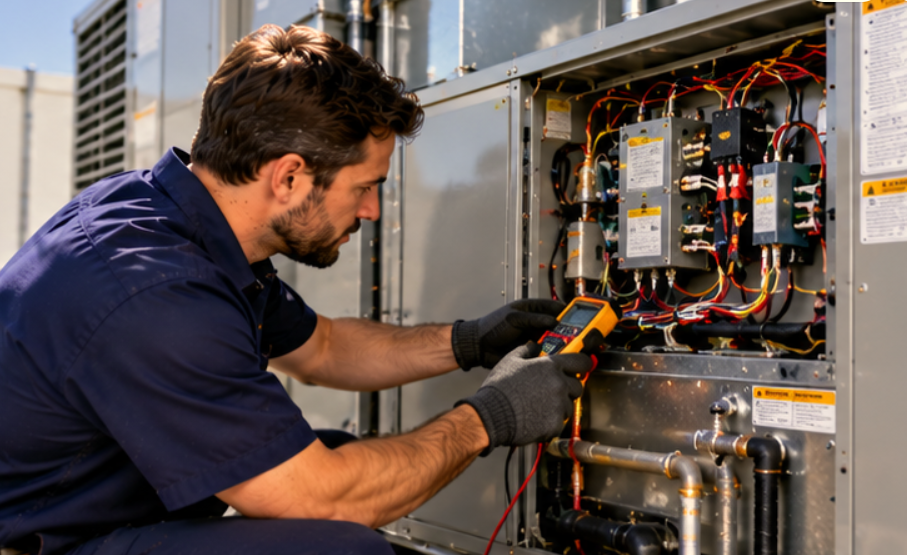
Commercial rooftop and split systems commonly last 15 to 20 years in this climate, less when they have run hard through long cooling seasons without documented maintenance. One expensive repair on a twelve-year-old unit is not grounds for replacement. A pattern of them on an eighteen-year-old unit usually is.
The test worth applying is whether the repair buys you seasons or weeks. A failed compressor on a unit past fifteen years rarely pays back, and a diagnostic visit for commercial HVAC repair will tell you what is failing and whether the remaining capacity still matches the space. Our post on getting commercial HVAC ready for summer covers the seasonal checks that catch this earlier.
Frequently Asked Questions About Commercial HVAC Costs
Why are my three commercial HVAC bids so far apart?
Almost always because they price different work. One covers equipment only while another includes duct resizing, electrical upgrades, crane, permits and disposal. Ask each contractor to itemize, then compare line against line. A wide gap usually traces to one missing item rather than to anyone’s markup.
Can I reuse the existing ductwork and save that line entirely?
Sometimes, where the ducts are sized for the new tonnage, sealed and in sound condition. A static pressure test answers it in under an hour. On older buildings the ducts are often undersized for current capacity, which chokes airflow and costs you the efficiency you just paid a premium to buy.
How long does a two-unit rooftop replacement take?
A straightforward changeout with existing curbs and adequate electrical often runs two to four days, including the crane day. Add duct modification, panel work or a permit inspection that lands badly in the schedule and it stretches to two weeks. Equipment lead times move the start date more than the work itself does.
Does a higher-efficiency unit pay for itself in Modesto?
More readily than in a mild market, because the equipment runs long hours through a long cooling season and efficiency compounds across runtime. Look at EER2 rather than the SEER2 headline, since EER2 measures performance at high outdoor temperatures, which is the condition your building operates in all summer.
Should I replace both units at once or stagger them?
If both are the same age and past fifteen years, replacing together usually costs less per unit, because the crane, permit and mobilization are shared across one project. If one unit is materially newer, staggering preserves its remaining life. The age gap between them is what decides it.
Why Choose Dycus Heating and Air Conditioning for Commercial HVAC Replacement in Modesto, CA?
We have handled commercial and light commercial HVAC across Modesto and Stanislaus County since 2001, which covers rooftop units, chillers, cooling towers and ventilation. That range matters on a budget question, because we are not steering every building toward the one system we happen to install.
Our technicians are NATE-certified, and we run a load calculation on the building before naming a tonnage rather than working backward from floor area, so the equipment matches the heat your building actually gains.
We quote commercial HVAC installation and replacement as itemized lines, with ducts, electrical, crane, permits and disposal priced separately, so you can compare our bid against any other on equal terms. Estimates are free and 0% APR financing is available for qualified customers.
Before you compare bids, get a load calculation and an itemized scope so all three numbers describe the same job. Call (209) 544-8072 to arrange one for your office. A square-footage estimate is where a budget conversation starts, and it is not where a purchase decision should end.