
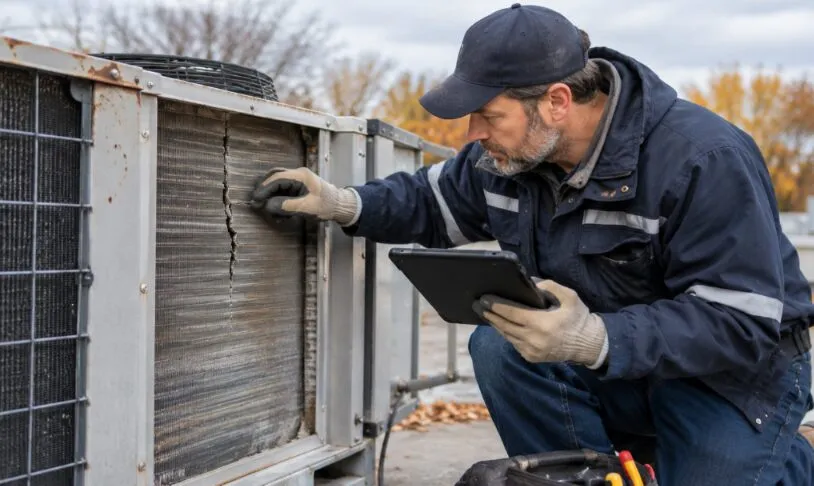
A cracked heat exchanger on a rooftop unit cannot be safely welded or sealed. You can put in a new heat exchanger or a new rooftop unit. On a unit about 15 years old or more, a new unit is usually the better buy.
For Modesto building owners, Dycus Heating and Air Conditioning prices both rooftop repairs and full replacements. This guide covers why a crack matters and what decides the choice. It also shows how to keep the building safe until the work is done.
What a Cracked Heat Exchanger Means
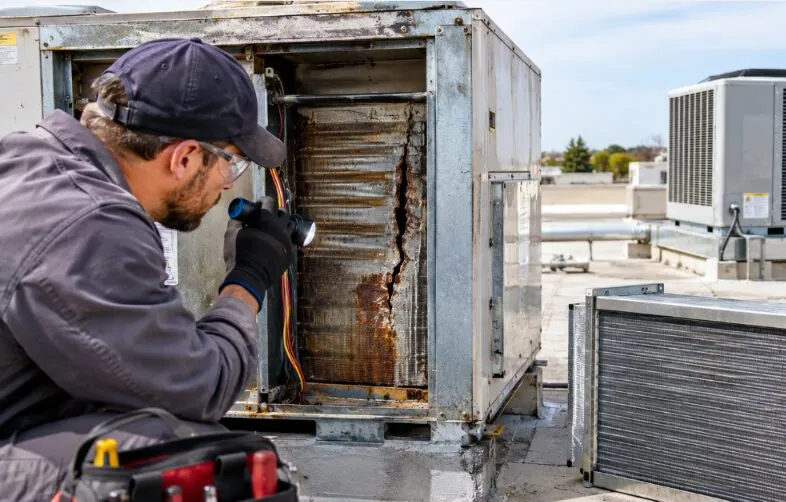
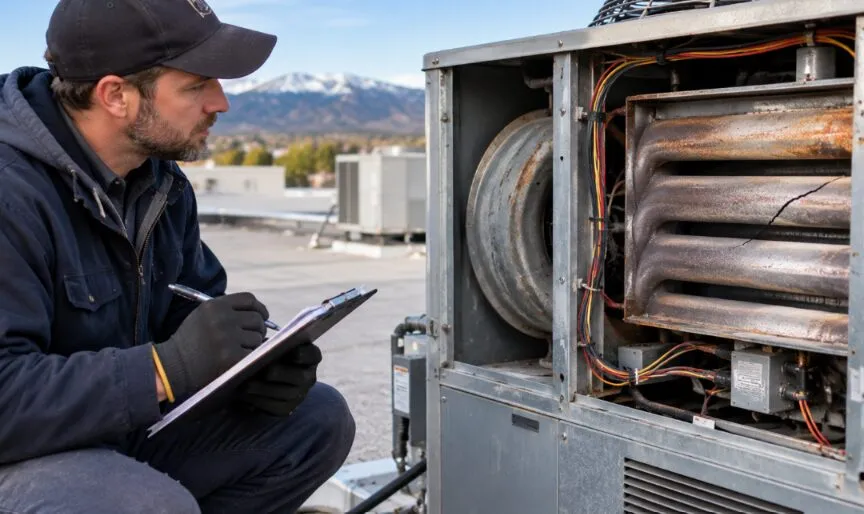
In a gas rooftop unit, the heat exchanger is the metal chamber that keeps the burner flame and its exhaust apart from the air blown into your building. Air passes over the outside of the chamber and picks up heat without touching the gases inside.
A crack breaks that seal. Combustion gases, including carbon monoxide, can leak into the air your building breathes. The CDC describes carbon monoxide as a gas with no color or smell, so nobody will notice a leak until people feel sick.
Cracks come from metal fatigue. Each heating cycle stretches the chamber, and each cool-down shrinks it again. After thousands of cycles, weak spots split. On a Modesto roof, the metal also bakes through triple-digit summers before it ever runs a cold winter.
Why Not Weld the Crack?
It is a fair question, since a weld costs less than a new part. The trouble is that the metal around a crack is already worn out. A weld or sealant may hold for a while, but the next run of heating cycles opens a new crack nearby.
Manufacturers agree. Trane, for example, advises against repairing a cracked heat exchanger in a gas furnace. It points owners to a replacement instead. A patch also leaves you carrying the risk if gases reach the people working below.
That leaves two safe paths, and the rest of this guide helps you choose before the cold weather arrives.
Five Factors That Decide the Repair
A new heat exchanger makes sense on some units and wastes money on others. Five factors usually decide it. On an older rooftop unit, two or three of them tend to point the same way.
Age of the Unit
Rooftop units often last about 15 years, depending on care and conditions. A new heat exchanger on a five-year-old unit buys many more years of service. The same part on an older unit goes into equipment that is worn in every other section too.
Parts Availability
Each heat exchanger is made for one model, and older models may have few or no parts left. A long wait can mean weeks without heat. Ask for a confirmed part number and delivery date before you approve anything.
Condition of the Cooling Side
The heat exchanger is only one part of the unit. A worn compressor, or a system on R-22, makes the cooling side a big expense of its own. The EPA ended new R-22 production and imports in 2020. Fixing the heat while the cooling fails in summer means paying twice.
Cost Next to a New Unit
We price commercial work by hand, so you see the new heat exchanger and the new unit side by side. A heat exchanger job takes a lot of labor, since the section must be opened and sometimes lifted out. On an older unit, that labor narrows the price gap.
Building Needs and Timing
A unit serving a busy office or a restaurant cannot sit without heat for weeks while parts arrive. Sometimes timing decides it. A new unit that is in stock and can go in quickly beats a part that arrives in February.
Cooling-Only Use Until Spring
Some owners would rather skip heat for the winter. Winters here are mild, people and equipment warm the office, and the unit still cools fine. Running on cooling only until spring can work, but only if the heat section is shut down properly first.
Switching the heat off at the thermostat is not enough. A schedule change or an employee can still call for heat. The burner lights, and gases can reach the supply air through the crack. The gas supply to the heat section has to be shut off and tagged.
Cooling only also means no heat through the cold spells of December and January. Keep working carbon monoxide alarms in every occupied area served by gas heat. If you go this route, book the replacement now, before the spring rush.
New Heat Exchanger or New Unit
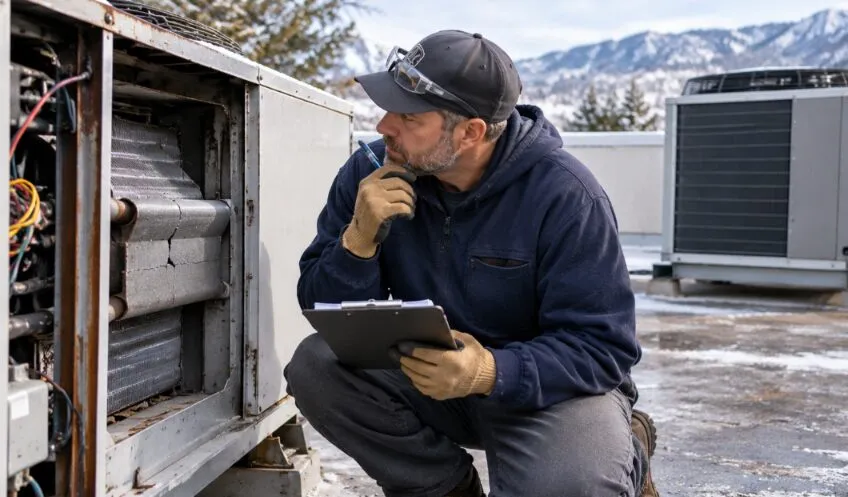
Both are sound repairs when done right. This comparison covers the points that matter most for an older rooftop unit. Use it with your technician’s quotes, since every unit and roof is a little different.
| Factor | New heat exchanger | New rooftop unit |
|---|---|---|
| Best fit | Units under about 10 years old | Units past about 15 years old |
| Downtime | Depends on part lead time | Short once the unit is on site |
| Crane | Sometimes needed | Usually needed |
| Rest of the unit | Compressor, fans and controls stay the same age | Every component is new |
| Refrigerant | Stays on the existing refrigerant | New units use newer, lower-impact refrigerants |
| Long-term cost | Lower upfront, more repairs ahead | Higher upfront, lower repair risk |
If a new unit makes sense, our 10-ton rooftop unit cost guide breaks down the installed price, from the crane to the permit. Buildings with several aging units can also weigh replacing them at once or in stages.
How a Technician Confirms the Crack
A crack should be backed by clear findings, not a guess or one odd reading. A technician may look inside with a mirror or camera, watch the flame when the blower starts, and test the flue gases and the supply air for carbon monoxide.
No single test settles it. Ask what was found and which tests were run. If a carbon monoxide alarm sounds, leave the building and call emergency services from outside.
Rooftop Heat Exchanger Repair and Replacement
A cracked heat exchanger is rarely the whole story on an older unit. Weigh age, parts, the cooling side, cost and timing together. Our commercial HVAC technicians work on gas and heat pump rooftop units. They can price both paths for you.
Every visit for commercial HVAC repair begins with a diagnostic per unit, and that fee does not apply to the repair. You know what is wrong before you choose.
When a new unit is the better choice, we handle commercial installation and replacement, from removing the old unit to starting up the new one.
Dycus Heating and Air Conditioning is a Modesto family business that started in 2001. Google reviewers give us 4.9 stars, and our BBB accreditation dates to 2006. Our NATE-certified technicians trained on a course the owner wrote himself. They serve buildings across Modesto, Manteca, Ceres and Riverbank.
Call us to get both options priced before winter. Office hours are 7:00 AM to 5:30 PM on weekdays.
Frequently Asked Questions
How much does a commercial HVAC repair visit cost in Modesto?
Each rooftop unit we diagnose is $169 on a weekday. Overtime, weekend and out-of-area visits are $199, and a weekend visit more than 20 miles from our shop is $250. Once we know the problem, we quote the repair for your building before any work starts.
Can a rooftop unit be replaced in winter in Modesto?
Yes. Modesto’s mild winters rarely stop roof work, though rain and fog can shift the date. Plan the lift, roof access and tenant notices early, and allow time for the permit. A replacement booked in winter also avoids the spring rush, when cooling calls fill the schedule.
Is a commercial heat exchanger different from a home furnace one?
It works the same way. A rooftop unit’s heat section sits outside on the roof and is often larger, with several burner tubes. Replacing it means opening the unit in winter weather. That adds labor and sometimes a lift, so the price gap with a new unit can be small.
What does RTU mean?
RTU stands for rooftop unit. It is a packaged system with heating, cooling and the fan in one cabinet on the roof. They are common on offices, shops and restaurants. The heat side is usually gas, though some RTUs are heat pumps with electric backup heat.
Do you service rooftop units outside Modesto?
Yes. Our service area reaches about 15 to 20 miles from the Modesto shop, taking in Manteca, Riverbank, Ceres, Salida and Turlock. Visits more than 20 miles out carry the out-of-area rate, because the drive ties up a technician for longer.