Skip to content

Half the floor is in sweaters, the other half has desk fans running, and the thermostat has not moved in a month. The setting is right, the equipment is running, and the complaints keep arriving every afternoon the sun hits the west side of the building.
That pattern almost never means the thermostat is broken. It means one sensor is governing rooms that carry different heat loads, and the system stops as soon as that one room is satisfied. This guide shows how to tell a repairable distribution fault from a structural zoning limitation.
Why Does One Side of the Office Run Hot While the Other Runs Cold?
A thermostat measures the temperature of the single spot it hangs on. A single-stage commercial system runs full output or nothing at all based on that reading. When the hallway hits 72 degrees, the equipment shuts down, whatever the southwest conference room happens to be doing at that moment.
Every room carries its own load from glazing, occupancy, lighting and equipment. The same airflow that satisfies a shaded interior office leaves a sun-loaded corner room short by several degrees. Gaps of 8 to 10 degrees between rooms on one thermostat are common in offices built before zoning was standard.
Modesto makes the gap worse than a coastal market would. Afternoon highs sit in the triple digits for stretches of the summer, and west and south-facing glass absorbs that load for hours while the north side of the floor stays shaded. The same floor plan behaves differently at 2 p.m. than it does at 9 a.m.
What Office Airflow Problems Should You Rule Out Before Zoning?
Before investing in a VRF system or redesigning a commercial HVAC layout, identify why different rooms are receiving different levels of heating or cooling. In a Modesto office, restricted airflow, duct leakage, equipment performance, or changes to the floor plan can create comfort problems that may be corrected without replacing the entire system. A technician should investigate these possibilities before recommending a major retrofit.
A room-by-room assessment can help distinguish an airflow problem from a genuine need for independent temperature control. Measurements such as supply airflow, system static pressure, and the temperature difference across the indoor coil provide useful diagnostic evidence. Results should be compared with the equipment manufacturer’s specifications and the building’s design requirements rather than judged against one universal range.
| What to Check | What the Findings May Indicate |
|---|---|
| Coil temperature split | An unexpected reading may indicate an airflow, refrigerant, or equipment-performance issue requiring further testing. |
| System static pressure | High pressure may point to restrictive filters, ductwork, dampers, or other airflow limitations. |
| Airflow at each register | Uneven delivery may indicate duct leakage, crushed runs, balancing problems, or design limitations. |
| Room-to-room temperatures | Persistent differences may reflect varying heat loads, airflow problems, controls, or a need for zoning. |
Filters, Registers, and Blocked Supply
Start with straightforward restrictions that can affect how conditioned air reaches different parts of the office. A loaded filter, obstructed register, or incorrectly positioned damper can reduce airflow and contribute to uneven temperatures. Check these conditions first, then measure airflow again to determine whether the restriction was contributing to the problem.
Duct Leakage and Damaged Runs
Duct joints can loosen, and flexible ductwork can become crushed or damaged above suspended ceilings. These defects may allow conditioned air to escape or restrict delivery to rooms farther along the branch. A technician can inspect accessible ductwork, measure airflow, and use static pressure readings to help determine whether sealing, repairing, or balancing the system is appropriate.
Equipment Performance and Cooling Capacity
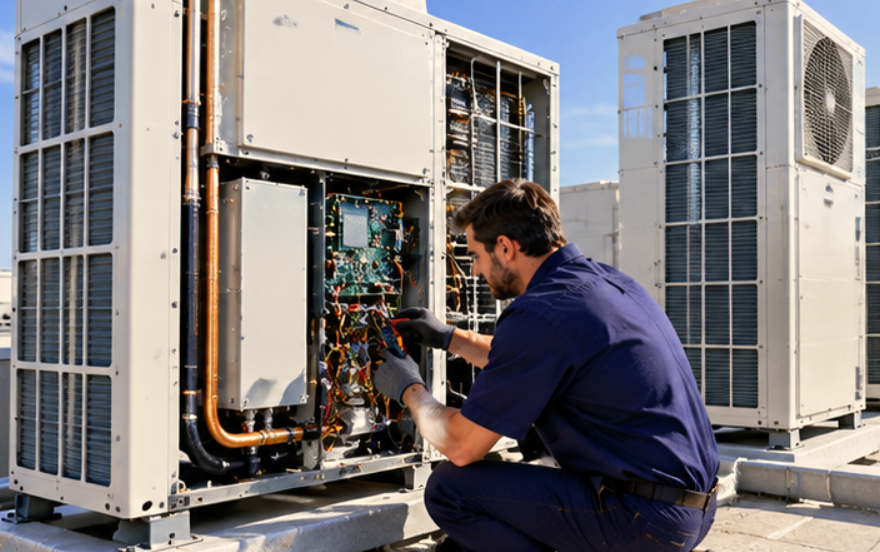
If several rooms struggle to maintain their thermostat settings, the existing equipment may not be delivering the expected cooling capacity. Dirty condenser coils, airflow restrictions, refrigerant problems, or failing components can affect performance. A professional diagnosis and commercial HVAC repair in Modesto can help establish whether the equipment needs repair before zoning or replacement is considered.
Floor Plan Changes and Uneven Heat Loads
Office renovations can change how heat enters and moves through a commercial space. New partitions may obstruct supply registers, while conference rooms, added equipment, and sun-exposed windows can create different cooling demands from those anticipated by the original duct design. If comfort complaints began after a remodel, compare the current layout and room loads with the existing system’s design before deciding whether zoning is needed.
The goal is to establish whether the current system can deliver adequate airflow and capacity to the rooms it serves. If repairs and balancing resolve the temperature differences, a VRF retrofit may not be necessary. If distinct room loads persist despite a properly functioning distribution system, independent zone control may be worth evaluating as part of a broader commercial HVAC plan.
How Does a VRF System Fix Uneven Temperatures?
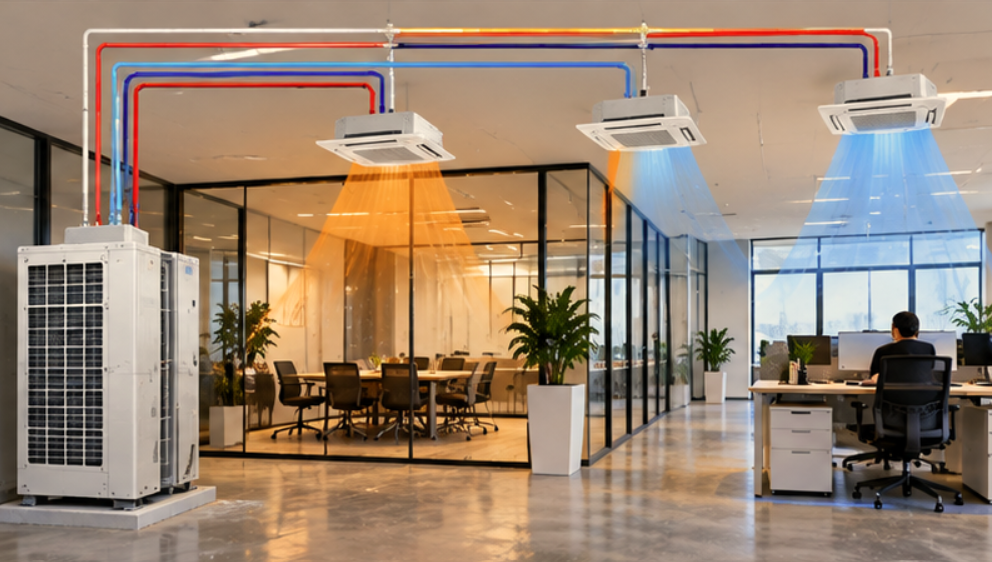
VRF stands for variable refrigerant flow. One outdoor condensing unit feeds refrigerant to many indoor heads, and each head modulates independently to its own sensor. The sun-loaded conference room can draw more capacity at the same moment the shaded office draws less, from one refrigerant loop.
The compressor is inverter-driven rather than fixed-speed, so it ramps output to match total demand instead of cycling hard on and off. Heat recovery configurations go further and move heat from a room that needs cooling into one that needs heating, which is useful on Central Valley shoulder-season days.
One outdoor unit commonly serves a dozen or more zones, which is what makes per-room control practical without running a dozen separate systems. Our explainer on how variable refrigerant flow works covers the indoor head types, from ceiling cassettes to slim wall units and fan coils.
How Does VRF Compare With a Conventional Ducted System?
The table below is the argument in one view. A conventional ducted system was never designed to deliver different amounts of cooling to different rooms at the same time, which is precisely what an office with varied glazing and occupancy asks of it every single afternoon.
| Feature | Conventional ducted system | VRF |
|---|---|---|
| Control | One thermostat for the floor | Independent sensor in each zone |
| Capacity | Full output or off | Modulates to each room’s load |
| Simultaneous modes | One mode for the whole floor | Heating and cooling at once with heat recovery |
| Zones per outdoor unit | Typically one | A dozen or more |
| Ceiling space needed | Full duct network | Refrigerant lines and branch boxes |
Note the last row, because it matters in a retrofit. VRF runs copper lines rather than sheet metal, so it threads through occupied buildings with less demolition than a new duct network would require, and zones can often be commissioned in stages across several weekends.
Is a VRF Retrofit Worth the Investment?

VRF costs more than anything else on this list, and the gap is wide enough that it belongs in a capital plan rather than a repair budget. A full-floor retrofit in a Modesto office generally runs $18 to $30 per square foot installed, with zone count and electrical scope deciding where inside that band you land.
Our own commercial VRF systems page puts the return on a major retrofit in the 12 to 14 year range, which is an honest figure rather than a flattering one. That horizon suits an owner-occupied building or a long lease. It suits a tenant with four years left on a term considerably less well.
Modesto buildings are served by the Modesto Irrigation District rather than PG&E, so nearly every California rebate figure published online is the wrong one for this city. Check the MID rebate program before building incentives into a budget, because the programs and the amounts both differ.
Is There a Lower-Cost Alternative to VRF?
Here is the position we take with building owners, and it costs us work: most hot and cold complaints are not VRF projects. If the equipment has years of life left and the loads are not wildly different room to room, the money belongs in the distribution system instead.
- Air balancing, which adjusts dampers until each branch delivers its designed airflow
- Duct sealing and repair, which recovers the air currently escaping into ceiling cavities
- Zone dampers and controls, which split a compatible ducted system into two or three zones
- A single ductless head, which solves one problem room without touching the rest of the floor
Each of those is a fraction of a VRF retrofit, and the first two often cost less than one season of the complaints they resolve. VRF earns its price when the equipment is near the end of its service life, the floor plan carries genuinely varied loads, and the building was facing a commercial HVAC replacement anyway.
How Do You Keep a Zoned Office System Balanced?
A zoned system holds its balance only while it is maintained, because every sensor and control added is another component that can drift. Commercial equipment should be serviced twice a year, before cooling season and before heating, with each zone’s sensor reading verified against an independent thermometer.
- Filters on schedule, so airflow stays even across every head
- Sensor verification at each visit, rather than trusting the display
- Rebalancing after any remodel, since new walls change the load map
Our post on whether zoning fixes a hot upstairs and cold downstairs applies the same logic to a two-story building, where warm air rising through the stairwell adds a factor a single-floor office never has to contend with. Owners of two-story Modesto buildings should read that one alongside this.
Frequently Asked Questions About VRF Systems for Offices
How long does a VRF installation take in an occupied office?
A small suite with three to five zones usually runs one to two weeks. A full floor can take four to eight weeks depending on electrical scope and ceiling access. Most of the disruptive work can be scheduled for evenings and weekends, and zones are commissioned in stages so the office keeps operating.
Will VRF lower my energy bills, or just fix the comfort problem?
Both, in most cases, though the size of the saving depends on your building rather than on any percentage a contractor quotes. Modulating to partial load uses less energy than cycling full-on and off, and zones serving empty rooms can be set back. Your MID rate decides what that is worth.
Can I add zoning to my existing ducted system instead?
Sometimes. A system with adequate capacity, sound ductwork and a compatible control board can take motorized dampers and a zone panel for a fraction of a VRF budget. It works best with two or three zones. Beyond that, airflow management gets difficult and VRF becomes the cleaner answer.
Why does one conference room only overheat when it is full?
Ten people, their laptops and the lighting add a substantial heat load the moment the room fills. A room comfortable at 8 a.m. can climb several degrees within an hour of a meeting starting, and a thermostat in a quieter part of the floor never sees that spike at all.
How long does a VRF system last?
Properly maintained VRF equipment runs in the same 15 to 20 year range as other commercial HVAC, with indoor heads often outlasting the outdoor unit. Service records matter more here than on simpler equipment, since manufacturers ask for documented maintenance when a compressor claim is made inside the warranty window.
Why Choose Dycus Heating and Air Conditioning for Commercial VRF Systems in Modesto, CA?
Dycus Heating and Air Conditioning has served Central Valley commercial properties since 2001, bringing experience in complex HVAC projects and building comfort requirements.
Our NATE-certified technicians evaluate airflow, temperature differences, static pressure, and control operation to help identify why different areas of a commercial building may not maintain consistent temperatures. For properties requiring advanced zoning and system coordination, our commercial HVAC team can help determine whether variable refrigerant flow technology fits the building’s layout and operating needs.
We provide free estimates and itemized project scopes so property owners can understand equipment, controls, electrical work, and other installation costs. We also handle applicable Stanislaus County permitting for the work we install, with 0% APR financing available for qualified customers. Contact our team to discuss your commercial HVAC requirements and VRF system options.