Skip to content

A renewal notice arrives, or a technician mentions a plan after a repair, and you are left deciding whether you are buying genuine upkeep or a discount on work you may never need. The honest answer depends on your system’s age, how many units you run, and whether you would book service on your own.
For most Modesto homes the plan wins, and the reason is runtime rather than salesmanship. Our plan runs $189 a year for the first unit and $169 for each additional, against roughly $240 to $400 for two separately booked tune-ups. This guide shows where that math holds and where it does not.
How Much Does an HVAC Maintenance Plan Cost in Modesto?
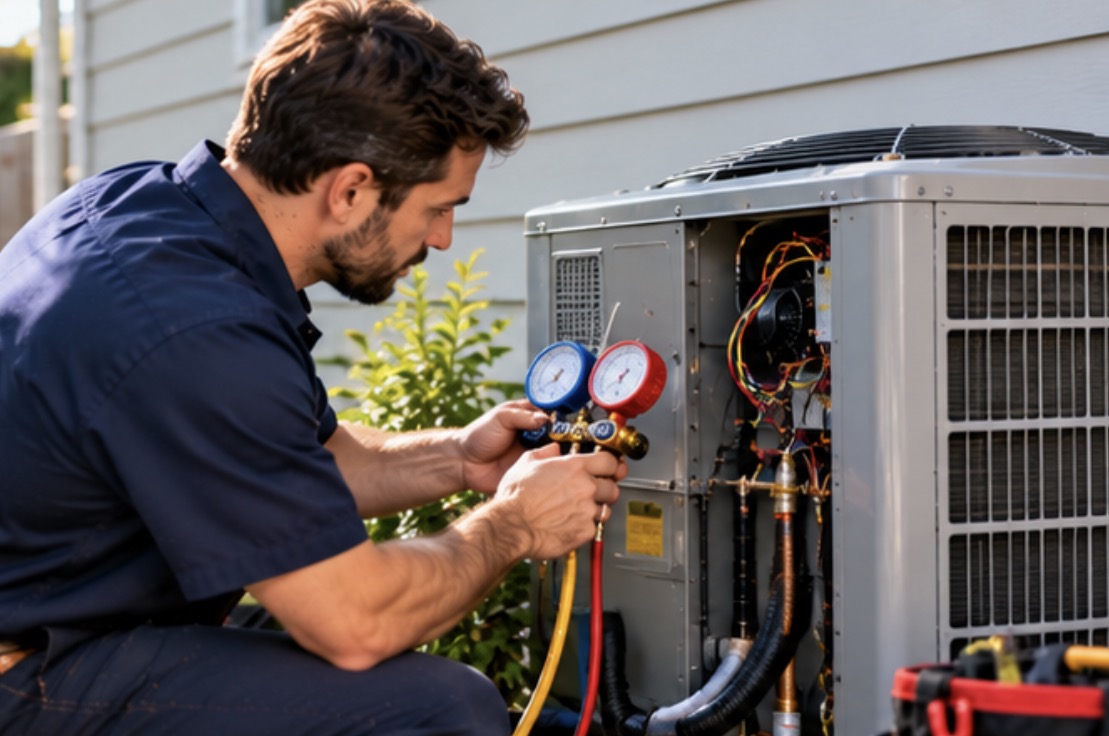
Plans here generally bundle two seasonal visits, priority scheduling and a repair discount into one annual fee. Ours is $189 for the first unit and $169 for each additional, including 15% off repairs across the year. Comparing that against paying as you go is straightforward arithmetic.
| What you are comparing | General Modesto range | Notes |
|---|---|---|
| Single air conditioner or furnace tune-up, booked alone | $120–$200 | Per visit, per system |
| Two separate visits across the year | $240–$400 | Spring cooling, fall heating |
| Annual maintenance plan, first unit | $189 | Covers both seasonal visits |
| Each additional unit on the plan | $169 | Second system, or a rental property |
| Typical repair on an air conditioner or furnace | $150–$650 | 15% off under the plan |
Run those lines for a single-system home and the plan costs less than booking the same two visits yourself. Add a second unit, or one repair across the year, and the gap widens further. Rates vary by company, so ask any contractor for their per-visit figure.
When Does a Maintenance Plan Pay for Itself?
For a typical Modesto home the recurring fee usually pays for itself, and runtime is why. An air conditioner here works from late spring into fall, so a part running on the edge has months to become a failure rather than the few weeks it would get in a milder market.
What decides it is how much the plan prevents rather than what it includes. If two visits, priority booking and a repair discount head off one emergency call in July, the fee has already returned, and peak-week availability is the genuinely scarce thing it buys you.
The case weakens on a newer single system owned by someone who books service reliably anyway. A plan does not make a technician better or stop a control board failing. What it changes is whether small drift gets caught before the week everyone else is calling.
What Does an HVAC Maintenance Plan Include?
A genuine tune-up is a set of measurements rather than a filter swap, and most need gauges to interpret. The checks below are worth confirming appear on any plan you consider, because a visit that skips them is a visual inspection wearing a different name.
Refrigerant Charge and Temperature Split
Temperature split is the difference between air entering the return and leaving the supply. A healthy cooling split runs roughly 16 to 22 degrees, and a low reading points at either charge or airflow. Refrigerant can leak slowly for months before the system visibly fails on a hot afternoon.
Capacitor and Electrical Readings
The capacitor gives the compressor and fan motors the jolt they need to start, and Central Valley heat is hard on it. Measured capacitance drifts below its rating long before failure, which makes it the single most common reason an air conditioner will not start in July.
Condensate Drain Cleaning
Cooling pulls humidity from the air, and that water leaves through a narrow line that grows algae across a long season. A clogged drain backs water into the pan, trips the float switch and shuts the system down. It costs little to clear and is routinely skipped on a quick visit.
Airflow, Filter and Blower Health
Airflow is where cooling capacity lives or dies. A loaded filter, a dirty blower wheel or a crushed duct starves the coil, drops the split and can ice the coil over. Blower amp draw gets read against its rating, since a motor pulling high is a motor heading for failure.
Service Records That Protect Your Warranty
Many manufacturers require documented annual maintenance to keep the parts warranty valid, which gives that paperwork a dollar value. If a compressor fails inside the warranty window the manufacturer can ask for service records, and a missing history is a common reason claims get questioned or denied outright.
Does an HVAC Tune-Up Lower Your Energy Bills?
Neglect costs money quietly, in two ways that compound across a season. A fouled coil cannot reject heat well, so run times stretch to reach the same temperature. A loaded filter raises static pressure, which means the blower works harder while moving less air through the same ductwork.
A dirty coil and filter together can raise energy use by roughly 10 to 15 percent. Across a Central Valley summer that runs thousands of cooling hours, the loss accumulates far faster than it would in a coastal market where the equipment sits idle half the season.
Modesto households are served by the Modesto Irrigation District rather than PG&E, so the rate you pay for that wasted electricity differs from most California comparisons you will read online. Check your own MID bill before assuming any published savings figure applies to your house.
How Often Should You Service HVAC in Modesto?
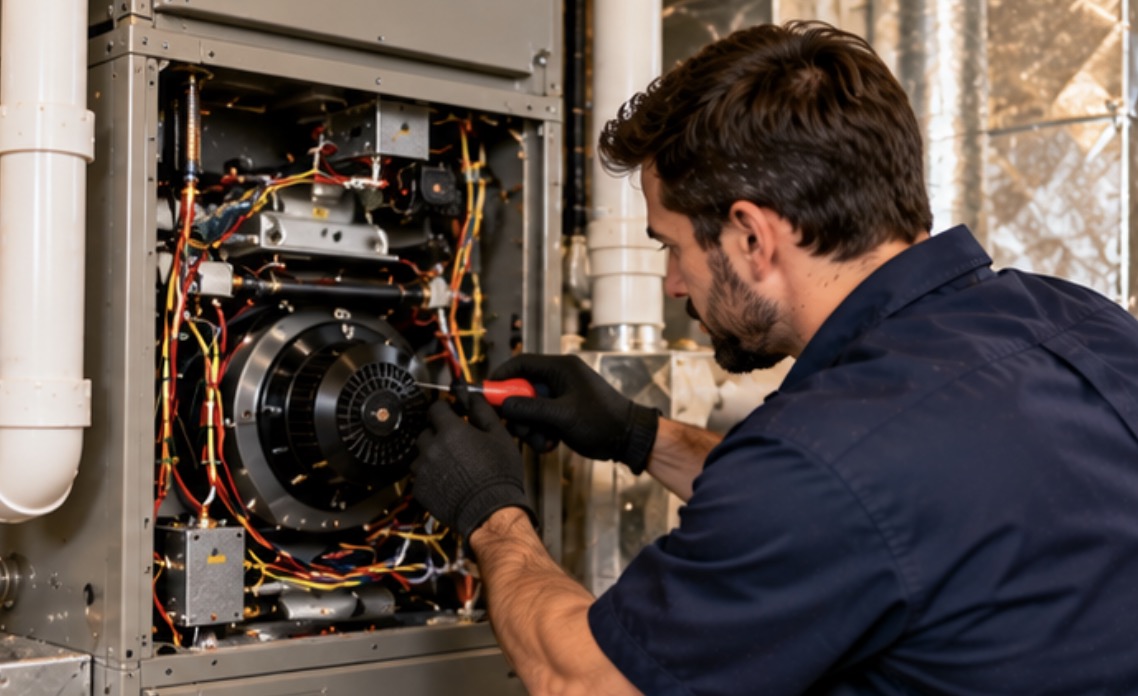
Twice a year is the working standard, and conditions in this valley favor it over a single annual visit more than most markets do. Service cooling in spring and heating in fall, so that faults surface before the season that would strand you rather than in the middle of it.
| Timing | What gets checked | Why it matters here |
|---|---|---|
| Spring | Charge, coil, capacitor, condensate drain | Catches weak parts before months of triple-digit runtime |
| Fall | Heat exchanger, ignition, blower, filter | Confirms safe heating before the first cold mornings |
| Between visits | Filter changes on your own | Valley dust loads filters faster than label intervals assume |
Shoulder seasons here often run heat in the morning and cooling the same afternoon, so both halves of the system see demand with little rest. Booking furnace maintenance in fall catches ignition and safety faults while there is still time to order a part.
Which Parts Does Modesto Heat Wear Out First?
Central Valley cooling runs long and hot, with triple-digit stretches common from June into September. Through those weeks an air conditioner may run close to continuously, and that sustained duty changes both how components fail and how quickly a small drift turns into a breakdown on the worst possible afternoon.
- Coils foul faster under constant airflow and valley dust
- Capacitors are stressed by months of heat and frequent starts
- Refrigerant charge drifts unnoticed until a peak-demand afternoon
- Condensate drains clog across an unbroken cooling run
- Blower motors work hard with no seasonal rest
A spring visit catches those components before the heat they would otherwise fail in, which is precisely the week when getting any technician out is hardest. Scheduling air conditioning maintenance in April rather than July is most of the advantage a plan buys you.
Is a Maintenance Plan Worth It for a Heat Pump?
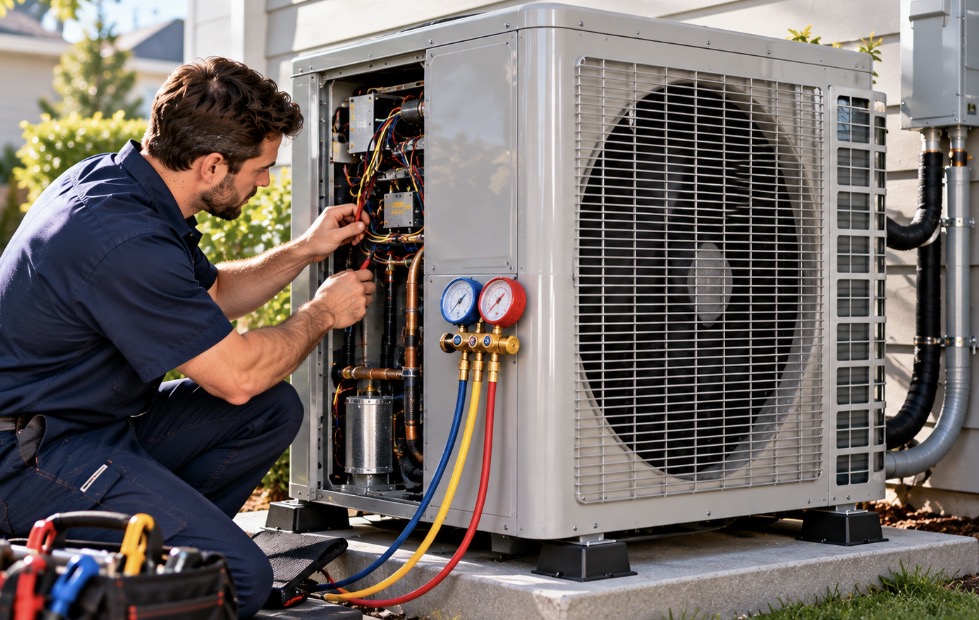
The case is arguably stronger. A furnace and air conditioner split the year between two machines, each resting half of it. A heat pump is one system doing both jobs, so it never gets an off-season and accumulates roughly twice the operating hours on the same components.
Heating efficiency is rated by HSPF2, a seasonal measure of heat delivered per unit of electricity. A low charge, a dirty coil or a struggling defrost cycle erodes that quietly, so you keep paying for efficiency the equipment is no longer delivering back to the house.
Variable-capacity equipment depends on clean coils and a correct charge to reach its rated numbers, which is why charge gets measured on gauges rather than estimated by feel. Keeping a heat pump serviced is what protects the efficiency you paid a premium to buy in the first place.
When Is an HVAC Maintenance Plan Not Worth It?
Plenty of homes should skip one, and it is worth saying plainly rather than selling past it. If you own a single system under five years old, change filters on schedule and reliably book a spring visit yourself, the plan’s convenience is worth less to you than to most.
The other case is a system far enough past its prime that upkeep no longer changes the outcome. A well-maintained unit generally lasts 15 to 20 years, and at eighteen with repeat faults, the money is better held toward air conditioning replacement than spent tuning a system on its way out.
Here is the advice we give callers who ask us straight: if you have never skipped a service visit in five years, you are already getting most of the benefit. The plan mainly buys you the discipline and the priority slot, and you may not need either one.
Frequently Asked Questions About HVAC Maintenance Plans
How long does a maintenance visit take?
A single-system tune-up usually runs 60 to 90 minutes if the technician is taking actual readings rather than glancing at the unit. Two systems take proportionally longer. A visit finished in twenty minutes has skipped most of the measurements that make the appointment worth booking.
Can I just change the filter myself and skip the plan?
Filter changes help airflow but cover a fraction of the job. A full tune-up also reads refrigerant charge, temperature split, electrical connections and the condensate drain, none of which can be assessed by looking. The filter is the easy part, and the measurements are what catch trouble early.
Does the plan cover parts and repairs, or only the visits?
Plans generally cover the scheduled visits and discount repairs rather than including them. Ours discounts repairs by 15%. Read any plan carefully here, because one marketed as covering your system and one covering two visits are different products sold at similar prices.
Will a tune-up fix a high summer electricity bill?
It can, where the cause is a dirty coil, low charge or restricted airflow. If bills keep climbing on an older system after a service visit, the tune-up has told you something useful: the problem is worn equipment rather than maintenance, and no amount of tuning will reverse that.
Is the plan transferable if I sell the house?
Ask before you sign, because policies differ between companies. Some transfer to the new owner for the remainder of the term and others end at closing. The documented service history usually transfers either way, and that is the part a buyer’s inspector will care about.
Why Choose Dycus Heating and Air Conditioning for HVAC Maintenance in Modesto, CA?
We have serviced Central Valley systems from our Modesto shop since 2001, and our technicians are NATE-certified, which matters on a maintenance visit because the value sits in the measurements rather than the visit itself. Charge, split, capacitance and amp draw get read and recorded, not estimated.
Our plan is $189 a year for the first unit and $169 for each additional, covering both seasonal visits and 15% off repairs across the year. We log what each visit found, which is the record a manufacturer asks for if a compressor or coil claim is ever questioned inside the warranty window.
If a visit shows the system is past the point where maintenance helps, we will tell you that rather than selling another year of tuning. Where replacement becomes the better use of the money, financing through Wells Fargo and Synchrony is available for qualified customers.
If you want a straight answer on whether a plan fits your home rather than a sales pitch for one, call (209) 544-8072. Our air conditioning service team will look at the system’s age and condition before recommending anything at all.