Skip to content

Your furnace ran for a minute on the first cold night and quit, and the quote you were handed is hundreds above what a neighbor paid for what sounds like the same fault. The gap is usually genuine rather than dishonest, because the same symptom traces to parts that are nowhere near the same price.
Most Modesto furnace repairs land somewhere between $150 and $650, with a cracked heat exchanger reaching $1,500 to $3,500 and often ending the conversation entirely. This guide covers what sits behind each number and how to read an estimate before you approve it.
Why Do Furnace Repair Prices Vary So Much in Modesto?
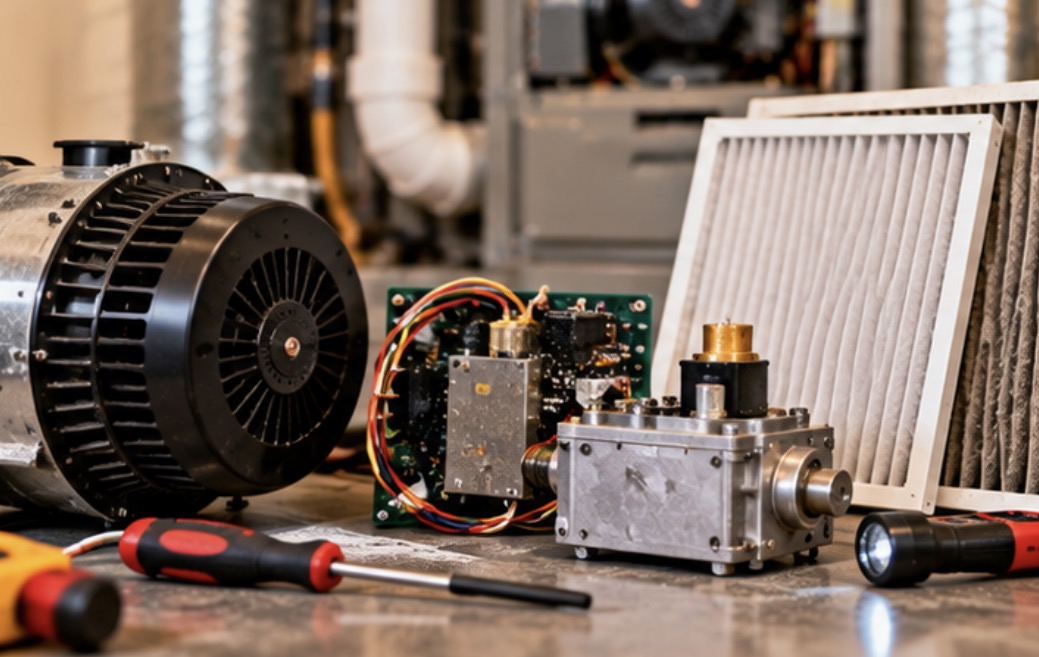
No single price exists because one symptom can trace to several parts. A furnace that fires then quits might have a carboned flame sensor, a failing igniter, or a venting fault, and those three bills are not close to each other. Until someone tests the unit, any quote is partly a guess.
Timing drives it too. Central Valley furnaces sit idle most of the year and work hard only from roughly November through February. Most failures surface on the first cold night, when a system that has not run since spring is asked to perform, which concentrates every call into a narrow few weeks.
That crowding matters to your quote. When the schedule tightens, you may be comparing numbers written by shops in quite different states of busy, and the one with a three-week backlog has less reason to sharpen a price than the one with an opening on Thursday.
Which Five Factors Set the Price of a Furnace Repair?
Five variables move the number, and knowing them lets you ask sharper questions than “why so much?” Not every shop weighs them the same way, which is most of why two honest quotes on the same furnace can land several hundred dollars apart without either one being padded or unreasonable.
- Which part failed: a sensor is minutes of labor, a sealed assembly is hours
- The furnace’s age: older cabinets are slower to open and work inside
- Part availability: obsolete boards and inducers can take days to source
- Diagnostic time: whether a flat visit fee applies, and whether it credits back
- Shop rates: labor rate and parts markup differ widely between companies
A large share of Modesto housing stock is old enough that specific control boards, igniters and inducer motors are genuinely hard to find. That pushes both the part cost and the wait, and it is a legitimate reason one quote outruns another rather than a sign of padding.
Experience with that older equipment is where a furnace repair visit earns its money. A technician who has worked Central Valley furnaces for years usually knows which discontinued part cross-references to something still on a supplier’s shelf this afternoon, which turns a three-day wait into a same-day fix and takes the sourcing premium off your invoice.
How Much Does Each Furnace Repair Cost?
Repairs span a wide range, and knowing roughly where your fault sits on it tells you whether a quote is reasonable before you spend an afternoon collecting second opinions. The table below groups the common failures by what they typically cost installed, and why each one lands where it does.
| Repair | Typical installed range | Why it lands there |
|---|---|---|
| Thermostat fault or replacement | $150–$450 | Fast work, wide price spread on the device itself |
| Flame sensor clean or swap | $150–$300 | Minutes of labor, inexpensive part |
| Hot surface igniter | $200–$450 | Common failure, low-cost part, short labor |
| Blower motor | $450–$1,200 | Variable-speed motors carry electronics that cost |
| Inducer motor | $500–$1,300 | Expensive part, awkward access on older cabinets |
| Control board | $500–$1,500 | Costly part, sometimes replaced on suspicion |
| Heat exchanger | $1,500–$3,500 | Safety-critical, labor-heavy, usually a replace decision |
Treat those as broad planning ranges rather than Modesto quotes, because your own number depends on the specific furnace and how easily a technician can reach it. Use them to judge whether an estimate sits in a believable band, not to argue a contractor down to a figure you found on a web page.
Thermostat and Flame Sensor Repair Costs
Both sit at the low end of the range and account for a surprising share of no-heat calls. A flame sensor is a thin rod that confirms the burner lit, and when it carbons over the furnace fires then shuts down within seconds. Cleaning it is quick work, and it is the most common false alarm we are called out to.
Hot Surface Igniter Replacement Cost
The igniter is a ceramic element that glows to light the gas, and it fails often because it runs hot and grows brittle with every cycle. When it cracks, the furnace attempts ignition and never lights. The part is inexpensive and the labor short, which keeps it low on most estimates.
Blower Motor Replacement Cost
The blower moves heated air through the ducts, and a failure gives you a firing burner with no airflow, often after a period of loud humming. Cost depends heavily on type, since an older single-speed motor costs far less than a variable-speed one carrying its own electronics.
Inducer Motor and Control Board Costs
Both are high-cost parts, and on an older furnace either can be slow to source. The control board is the one worth questioning, because it is occasionally replaced on suspicion rather than on a reading. Ask which test pointed to it before approving that line.
Heat Exchanger Replacement Cost
This is the most expensive repair and the only safety-critical one on the list, since a crack can let combustion gases reach the air you breathe. On an aging furnace, a cracked exchanger is usually where replacement enters the conversation rather than a repair quote.
What Should a Furnace Repair Estimate Include?

A fair estimate does more than name a total. It separates the diagnosed fault, the specific part, the labor and any diagnostic fee, so you can see what you are paying for rather than approving a single number and hoping the breakdown behind it was reasonable.
| What the estimate lists | Why it matters to you |
|---|---|
| The specific failed part, named | Shows the fault was identified, not assumed |
| Labor and diagnostic fee, itemized | Lets you see what is parts against time |
| The test or reading behind the diagnosis | Separates a tested finding from a suspicion |
| Whether the diagnostic fee credits back | Changes your actual out-of-pocket cost |
Here is the advice we give every caller facing a big-ticket line: before approving a heat exchanger or a control board, ask to be shown what failed. A photo from an inspection camera or a meter reading takes two minutes to produce, and a shop that tested the fault will have one ready.
When Does Furnace Repair Stop Making Sense?
A furnace generally runs 15 to 20 years before replacement becomes the better value, so age is the first thing to weigh against a large repair. A repair that is easy to justify on a seven-year-old unit is hard to justify on one at eighteen.
A workable test is to multiply the repair cost by the furnace’s age and compare that against a new system. A $700 repair on a 15-year-old furnace gives you $10,500 against a replacement that may cost less, which is the point at which most owners stop spending on the old unit.
Modesto changes that arithmetic slightly, because the heating season here is short and mild. A furnace that would be worked hard elsewhere runs comparatively few hours, so a sound older unit can be worth keeping longer than a national rule of thumb suggests. A furnace replacement still wins once repairs repeat.
What Causes Repeat Furnace Repair Bills?
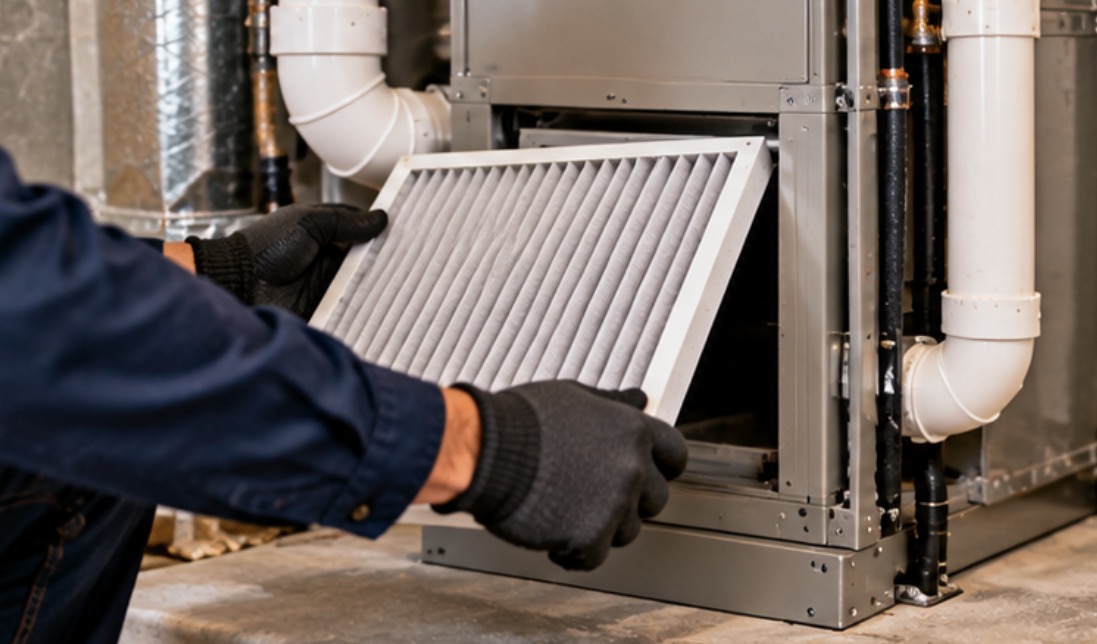
The driver behind repeat failures is usually airflow rather than the part that broke. Static pressure is the resistance your blower fights to push air through filters and ducts, and when it runs high the furnace overheats and stresses its own components until something gives.
Replace a blower motor without correcting that pressure and the new motor works exactly as hard as the old one did, which is how a household ends up buying the same part twice in four years. The causes owners most often miss are mundane and inexpensive to put right:
- A filter that is clogged, or rated too restrictive for the system
- Supply and return vents closed or blocked by furniture
- Undersized or crushed ductwork raising resistance across the whole system
- A dirty blower wheel the motor has to fight on every cycle
- A skipped tune-up that let a small fault compound through a season
One visit before heating season catches the carboned sensor, the weakening igniter and the rising static pressure while all three still cost little to correct. Regular furnace maintenance is what keeps a single repair from becoming three separate call-outs across one Modesto winter.
Frequently Asked Questions About Furnace Repair Costs
Is it worth paying a diagnostic fee just to find out what is wrong?
Usually yes, and most shops credit it toward the repair if you proceed. A flat fee buys a tested diagnosis. A quote written with no diagnosis behind it costs the same to produce and is worth considerably less, because you are paying for someone’s guess about which part failed.
How quickly can someone come out during a cold snap?
Central Valley failures cluster into the first few cold nights, so the schedule tightens hard in that window. Calling early in the season, before the rush builds, usually gets a faster slot. A shop that is genuinely booked will tell you plainly rather than promising a window it cannot hold.
Does a newer furnace cost more or less to repair?
It depends on the part rather than the age. Newer units use variable-speed motors and electronic boards that cost more each but are easy to source. Older units have simpler, lower-cost parts that can be difficult to find, which moves the cost into labor and waiting time instead.
Will my home warranty or insurance cover a furnace repair?
Home warranties sometimes cover mechanical failure but commonly exclude units that were not maintained, so keep your service records. Homeowners insurance rarely covers wear-related failure and may cover sudden damage from a specific event. Read the maintenance clause before assuming either will pay.
Can I keep running the furnace while I decide?
If the fault is a dead igniter or a thermostat, the furnace is not running anyway. If it is short cycling, overheating, or you have been told the heat exchanger may be cracked, switch it off at the service switch. A suspected exchanger crack is the one fault worth losing heat over.
Why Choose Dycus Heating and Air Conditioning for Furnace Repair in Modesto, CA?
Furnace repair costs depend on the failed component, diagnostic findings, parts availability, and labor involved. Dycus Heating and Air Conditioning has served the Central Valley since 2001, with NATE-certified technicians who explain the problem and identify the reason for the recommended repair before work begins.
We believe homeowners should understand what they are paying for. Our estimates explain the failed component and separate costs where applicable, helping you compare repair options before making a decision. If your furnace is making unusual noises, cycling frequently, or struggling to heat your home, our heating services in Modesto can help identify the cause.
For homeowners looking to reduce unexpected breakdowns, our annual maintenance plan costs $189 for the first unit and $169 for each additional unit, with 15% off repairs. If your furnace needs attention, call (209) 544-8072 to schedule service and get a clear explanation of the repair options and costs before deciding how to proceed.