Skip to content


The rooftop unit over your suite quit in August, your landlord says the lease puts it on you, and you are reading a maintenance clause written by someone else’s attorney. The frustrating answer is that both of you may be right, because the lease decides this rather than state law.
California’s habitability protections do not extend to commercial tenancies. There is no statute obliging a commercial landlord to keep your HVAC running, so what governs is the contract you signed. This guide covers which clauses decide it, what each arrangement costs, and what to negotiate before signing.
Does California Law Say Who Pays for Commercial HVAC?

No, and this surprises tenants moving from residential leases. California Civil Code sections 1941 and 1941.1 impose the implied warranty of habitability, and both apply to residential rental units rather than commercial premises. The doctrine traces to Green v. Superior Court in 1974 and stops at the residential line.
That means a commercial tenant cannot demand HVAC repairs on habitability grounds the way a residential tenant can. Where a house would carry a statutory floor beneath the lease, a retail suite or office carries only the terms the parties agreed. Silence in the lease does not default to the landlord.
Courts generally read commercial leases as arm’s-length agreements between parties assumed capable of negotiating. In practice, a tenant who takes premises without a specific landlord repair covenant may be treated as accepting them as they are. Getting the clause right before signing matters more here than almost anywhere else in the agreement.
How Do Lease Types Divide HVAC Responsibility?
The lease structure sets the starting point, though the specific wording always overrides the label on the cover page. Knowing which type you hold tells you where to look first, what you are likely to find when you get there, and which provisions are worth paying an attorney to read closely.
| Lease type | Who typically carries HVAC | What to verify |
|---|---|---|
| Triple net (NNN) | Tenant pays maintenance, taxes and insurance | Whether replacement is carved out or capped |
| Modified gross | Split, negotiated case by case | Exactly which systems sit on each side |
| Full service gross | Landlord, recovered through base rent | Whether CAM charges pass costs back anyway |
| Absolute net | Tenant, including capital replacement | Whether any cap or amortization applies |
Under a triple net lease the tenant generally takes maintenance along with taxes and insurance, which is the structure most Modesto retail and office suites use. Industry practice commonly leaves routine servicing with the tenant and major replacement with the landlord, but that split is a convention rather than a rule.
A full service gross lease keeps HVAC with the landlord on paper, which is why tenants stop reading at that point. Read the common area maintenance provisions anyway, because CAM charges are how a landlord recovers building costs from tenants, and servicing on shared equipment frequently appears inside them.
How Does a Lease Separate HVAC Repair From Replacement?
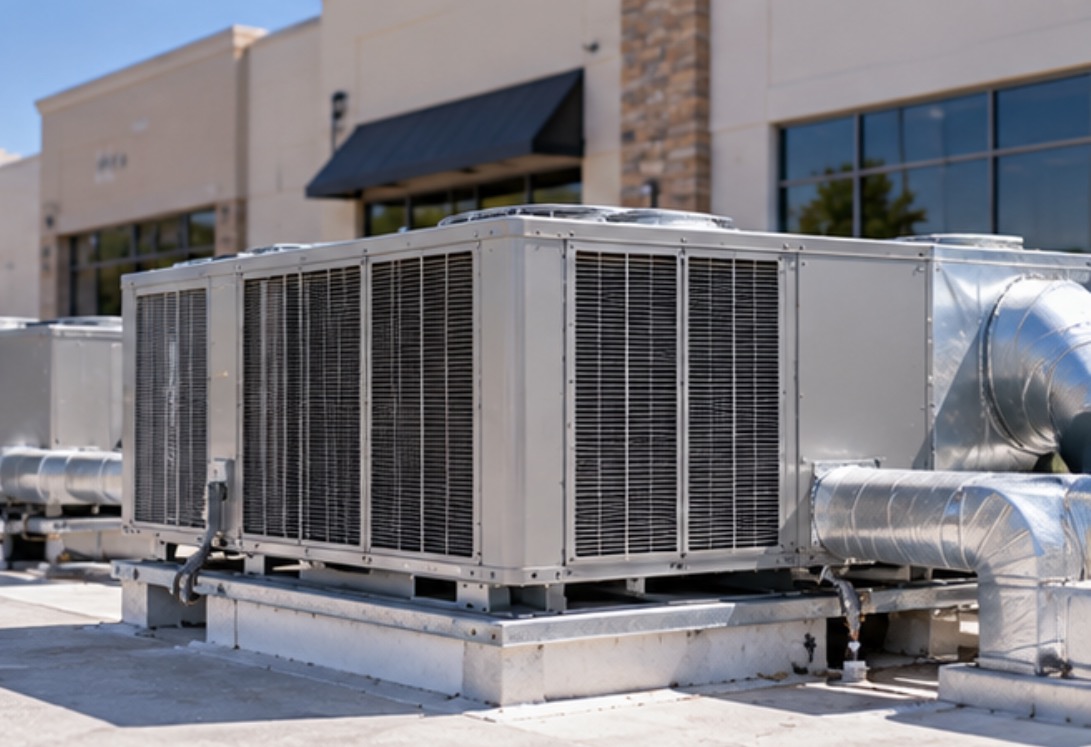
This is the distinction that produces most disputes, and many leases never define it. A repair restores a working system. A replacement installs a new one. The money involved differs by an order of magnitude, which is why the boundary gets argued after a compressor fails rather than before.
Property management practice generally treats repairs as chargeable to tenants while larger projects, such as replacing or substantially upgrading a system, stay with the owner unless the lease says otherwise. Without that language, a landlord may argue a $14,000 rooftop changeout is merely a large repair.
The clause worth negotiating sets a dollar threshold above which the cost shifts to the landlord, or amortizes a replacement across the useful life of the equipment so a tenant with three years left pays only three years’ worth. Either approach turns an ambiguous fight into arithmetic.
What Do Landlords and Tenants Pay for HVAC Work in Modesto?
Figures help more than principles when you are staring at a clause and trying to work out what it exposes you to. The ranges below are general Modesto-area estimates for commercial work, useful for judging whether a cost-sharing proposal is reasonable rather than for quoting any specific job.
| Work item | General Modesto range | Usually falls to |
|---|---|---|
| Quarterly maintenance visit, per RTU | $150–$350 | Tenant under NNN |
| Diagnostic call-out | $150–$350 | Tenant |
| Capacitor, contactor or sensor repair | $200–$700 | Tenant |
| Compressor replacement | $2,500–$6,000 | Disputed, depends on the clause |
| Full 5-ton RTU replacement, installed | $12,000–$22,000 | Landlord, where replacement is carved out |
| Full 10-ton RTU replacement, installed | $15,000–$32,000 | Landlord, where replacement is carved out |
The compressor row is where leases get tested. It is too expensive to absorb quietly and too small to be obviously capital, so a lease without a threshold leaves both parties arguing from one ambiguous sentence. Most commercial HVAC repair work sits well below that line.
Which Lease Clauses Decide HVAC Responsibility?
Five provisions decide HVAC liability between you and the other party, and they are rarely printed in the same part of the document. Read them together rather than in the order they appear, because one clause can quietly undo another sitting twenty pages away.
- The maintenance and repair covenant: whether HVAC is named, and who holds it
- Any HVAC carve-out: a specific clause overriding the general repair obligation
- Replacement and capital expense: whether replacement is excluded, capped or amortized
- CAM provisions: whether shared HVAC costs pass back through operating expenses
- The condition-at-delivery clause: whether the unit is warranted working at handover
The condition-at-delivery clause is the one tenants skip. If the lease delivers the premises as-is and the rooftop unit is already sixteen years old, you have accepted a system with little life left and a maintenance obligation attached to it from day one.
Get a California commercial real estate attorney to review the clauses before you sign. The figures above show what is at stake, and a provision that shifts a $20,000 replacement is worth more scrutiny than the rent escalation most tenants read twice.
How Can a Tenant Limit HVAC Risk Before Signing a Lease?
Ask for the unit’s age, make and model before signing, then have it inspected independently. A rooftop unit’s data plate gives its manufacture date, and a system past twelve years under Central Valley duty is near enough to end of life that the replacement question is live rather than theoretical.
Request the service history too. A landlord who can produce documented maintenance is handing you a system more likely to survive your term, and a gap in the records is a reasonable basis for asking for a condition warranty or a replacement threshold in the lease.
Here is what we tell tenants who call us before signing: pay for a pre-lease inspection. A few hundred dollars spent confirming the condition of equipment you may become responsible for costs little against inheriting a unit that fails in your first summer.
How Can a Landlord Protect Rooftop HVAC Equipment Under a Lease?
The opposite exposure applies to owners, and it is easy to miss while the rent arrives on time. A tenant holding full maintenance responsibility has little reason to service equipment properly in the final years of a term, which is how a landlord inherits a neglected rooftop unit at turnover.
The practical protection is to require documented quarterly servicing as a lease condition and to ask for the records annually. Scheduled commercial HVAC maintenance suits most suites, while monthly inspection fits high-demand facilities such as restaurants and data rooms where a failure is expensive.
Where a building carries several suites on shared equipment, naming in the lease who services the commercial and light commercial HVAC keeps standards consistent across tenancies rather than varying with whoever each tenant happens to hire. Our post on quarterly commercial maintenance covers what that schedule should include.
Frequently Asked Questions About Commercial Lease HVAC Responsibility
My lease says nothing about HVAC. Who pays?
The general repair covenant then governs, and its wording decides it. A clause obliging the tenant to maintain the premises in good condition has been read to include building systems. Silence does not default to the landlord in a commercial tenancy, which is why ambiguity usually favors whoever drafted the lease.
Can my landlord charge me for a full replacement under a NNN lease?
Possibly, where the lease does not exclude capital expenditure. Many NNN leases are written broadly enough that a landlord can argue replacement falls inside the tenant’s maintenance obligation. A cap, a carve-out or an amortization clause is what prevents that argument, and it has to be negotiated beforehand.
Can I withhold rent if the landlord will not fix the HVAC?
Rarely, and not safely without legal advice. The residential remedies of repair-and-deduct and rent withholding come from habitability statutes that do not apply to commercial tenancies. Withholding rent on a commercial lease risks default, so take advice before relying on a remedy that may not exist.
Who pays if the unit fails in the final month of my lease?
The lease governs, and timing rarely changes the obligation. This is one reason to negotiate amortization at signing, so a replacement is apportioned across the equipment’s remaining useful life rather than landing entirely on whoever happens to be holding the suite when the compressor quits.
Does a maintenance contract change who is responsible?
Not on its own. A service agreement records who arranged and paid for maintenance, which helps when a dispute turns on whether the equipment was looked after. Responsibility still flows from the lease, though good records are the evidence that usually settles which party met their obligation.
Why Choose Dycus Heating and Air Conditioning for Commercial HVAC in Modesto, CA?
Dycus Heating and Air Conditioning has served Modesto and Stanislaus County since 2001, providing commercial HVAC support for both property owners and tenants. Understanding both perspectives helps us address equipment problems, maintenance responsibilities, and repair-versus-replacement decisions in the context of a commercial lease.
Our NATE-certified technicians document findings and explain recommended work so property owners and tenants can better understand the condition of their HVAC systems. Whether a unit needs troubleshooting or a complete upgrade, our commercial HVAC repair services and commercial HVAC installation services help address the property’s specific equipment and operational needs.
We provide itemized commercial HVAC quotes, making it easier to review costs when repair expenses or replacement work involve landlords, tenants, or common-area maintenance budgets. For help with a commercial HVAC issue in Modesto, call (209) 544-8072 to discuss your property’s needs and available options.